The bill that reopened the government folds in cannabis restrictions billed as protecting children and preserving legitimate hemp businesses, but farms and dispensaries say it’ll eliminate virtually all hemp business — including in Bowling Green.
“If the bill doesn’t change, we will be out of business in 365 days,” said Clay Powell, whose family business Experimental Farms has a cannabis farm by Owensboro and sells products throughout the commonwealth, including in Bowling Green — referring to the law’s taking effect in a year. “All my products have THC in them, but they’re a thing you rub on your body for muscle aches and pains — they’re not getting anybody high.”
The chemical that people call THC, chemically known as “delta-9,” is the main substance in the cannabis plant that affects the mind, known for providing the high in high-inducing cannabis products, and relief for various medical conditions. The second-most well-known cannabis chemical after THC is CBD, which provides non-intoxicating effects such as topical pain relief through products such as oils.
Pushed by U.S. Sen. Mitch McConnell, the new restrictions, among other regulations, bans synthetic cannabis products and caps THC at 0.4 milligrams per container — a limit that numerous hemp industry stakeholders say is a death knell for hemp businesses. Numerous attorneys general as well as health and safety groups support the bill — which McConnell said “keeps these products out of the hands of children, secures the future of regulated hemp businesses, and keeps our promise to American farmers and law enforcement by clarifying the intention in the 2018 Farm Bill.”
That farm bill legalized hemp products — which it defined as products or extracts from cannabis plants where “delta-9” THC made up 0.3% or less of the plant’s dry weight. In doing so, it legalized a spectrum of cannabis products that effectively includes other THC variants capable of producing highs such as “delta-8” and “delta-10” THC — variants that child and hemp advocates have largely cautioned against due to research and regulation that are lacking.
This broad legalization of mind-affecting products has been deemed a loophole by McConnell, numerous groups and federal officials. Other stakeholders, such as the cannabis boutique Paper and Leaf’s owner Dave Keller, say the regulatory gap instead stemmed from a lack of intended follow-up federal regulations.
What is clear is that although McConnell has said the 2018 bill intended to support agriculture and textiles, it has effectively legalized a spectrum of cannabis products.
The bill enacted last week “preserves the legitimate hemp industry while addressing the rise of intoxicating and synthetic THC products,” McConnell said.
However, the U.S. Hemp Roundtable, which describes itself as the U.S.’s leading hemp business advocacy organization, stated the law will eliminate 95% of an industry that creates 328,000 agriculture and retail jobs — shuttering small businesses and costing states $1.5 billion in lost tax revenue.
Keller contends that the remaining 5% — for hemp serving industrial or research applications, which is protected in the bill — will go too, as hemp would become unprofitable to farm.
“This bill would effectively eliminate everything we sell everywhere,” Keller said.
Powell, a decadeslong Moss Middle School teacher who has run Experimental Farms since 2019, pointed to his family’s work in the community, their commitment to doing business right and the relief that their products provide community members with ailments, including chronic pain. The family’s products retain THC to work alongside CBD and provide relief — but that also prevents their products from being legal to sell under the new THC limit, he said.
“Hundreds of people (…) rely on our product to help them throughout the day,” he said. “The CBD that has a tiny bit of THC is helping them, and what’s the problem with that? … Those people are living a daily life … What’s the problem with an old lady rubbing CBD on her knees to help her walk around in the daytime? What’s the problem with someone soaking around in a bathtub because they have fibromyalgia — or any kind of ailment?”

Clay Powell, who owns and runs the CBD business Experimental Farms with his family, walks through his farm’s hemp field to check on their plants just outside Owensboro.
How to protect kids
The 2018 farm bill opened the pathway to a marketplace and industry estimated at $28 billion — but amid a largely uninhibited industry, the child population has experienced a surge in cannabis poisonings. In Kentucky, these poisonings for children under 18 increased sixfold from 2018 to 2024, to 212 poisonings, according to the Kentucky Injury Prevention and Research Center — one of many findings nationwide that indicated a critical need for solutions.
Supporters and opponents of the bill advocate for the same goal — protecting children’s health — but push different approaches:
Keller and other hemp industry business owners and advocates contend that the bill sidesteps years of discussions and advocacy with Congress intended to better regulate the hemp market and enforce those regulations, especially to restrict youth access. The bill’s supporters have argued that “trying to regulate hemp-derived THC products and other psychoactive products derived from hemp will not work.”
“These products remain widely available in many states that have tried to ban them,” states a letter signed by numerous health groups in support of the bill. “To protect the health and safety of our communities, we need to completely close the federal loophole by explicitly excluding these products from the definition of hemp.”
In contrast, a consensus of the hemp industry has advocated for what industry-members call four “pillars” of common-sense regulation, and better enforcement of them: age verification that keeps access only to adults 21 and older, strict testing requirements developed by independent labs, standardized labeling to better inform consumers, and standardized packaging to eliminate any marketing toward children.
“Pretty much the whole industry doesn’t want to market toward kids,” said Dwayne Carson, federal affairs director for the nonpartisan advocacy coalition Hemp Industry & Farmers of America, pointing to the four pillars. “We want sensible regulation at the federal level.”
U.S. Sen. Rand Paul, R-Kentucky, similarly condemned the bill in a Courier-Journal op-ed last week after forcing a failed U.S. Senate vote to remove the hemp restrictions.
“The hemp industry and I had already come to the negotiating table, in good faith, to discuss reforms that prevent ‘juicing up’ hemp products with purely synthetic cannabinoids of unknown origin,” Paul said.

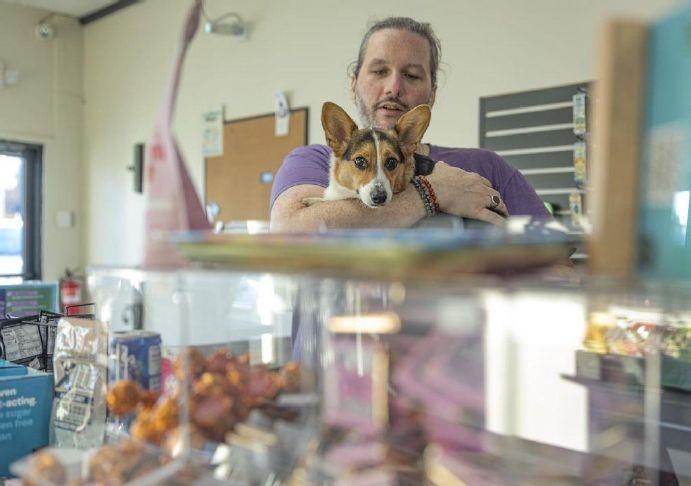
Paper & Leaf store mascot 2-year-old corgi Mable sidesteps near a row of edibles whose sale would be impacted by the recent federal 2026 Extensions Act at the hemp dispensary’s location in Bowling Green, Ky., on Monday, November 17, 2025. Gabi Broekema for The Daily News
Paul, Carson and Keller separately took issue that such legislation was enacted by attaching it to a crucial funding appropriations bill to reopen the government — rather than the hemp language individually passing the House or Senate.
Carson and Keller, separately advocating for hemp regulations and enforcement with Congress over the past three years, told the Daily News it’s incredibly difficult to gain traction on standalone bills due to the government partisanship. But doing so is important — and additionally so because the bill penalizes good actors and provides no enforcement for bad ones, according to Carson.
“A few senators and a House member took away a choice for your constituents,” said Carson, who expressed a belief that a bill containing the four pillars of regulations, with enforcement mechanisms and funding for them, could win bipartisan support. “This is why people don’t trust their government — because they do stuff like this without the people that represent you being able to vote (…).”
Bowling Green Independent School District Superintendent Gary Fields spotlighted what’s at stake locally in a statement of support for McConnell’s new bill — pointing to the proliferation of vaping products containing THC across retail outlets communitywide.
“These vapes are being purchased and used by students as young as 10 years old,” Fields wrote in a statement. “Students, who many times are trying vaping for the first time, are being exposed to intoxicating hemp products and the results are dangerous. We have created a system that does not provide safeguards to protect our K-12 students from these dangerous products.
I commend Senator McConnell for working to close these loopholes in order to protect every child in Kentucky.”
Personal stakes
Groups representing people who use cannabis — including Veterans of Foreign Wars of the United States and the VFW Auxiliary, which represents nearly 1.4 million veterans and their families — have opposed the bill for restricting products that for some individuals provide life-changing benefits.
CBD has provided immense relief in recent years to Warren County resident Lisa Mills, an Air Force veteran who suffered a traumatic brain injury from a concussive rocket blast while serving in Iraq in 2008. She took anywhere from 12-20 daily prescription medications to mitigate numerous mental issues from the injury, including PTSD, brain fog, and almost daily suicidal ideation.
But they effectively sedated Mills, leaving her unable to think or live freely, she said. And they largely didn’t prevent her from zoning out when PTSD took over: She recalled a time in Disney World when fireworks caused her to black out — believing she was in the desert again and going to die, until her husband comforted her and helped bring her back.
That began to change when she tried a hemp tincture in 2018, Mills said.
Since then, hemp products have allowed Mills to wean herself off all but one prescription medication — and live with far more clarity and peace.
“I was on CBD for several years, and it dawned on me: I no longer had those emotional and physical reactions, and I was more cognizant of my surroundings — I knew that fireworks was just fireworks. I was no longer locked inside my body in fear — and that’s the gift CBD gave me.”
It the bill takes effect, Mills — a customer at the local Paper and Leaf — said she’d lose out on the quality of product available.
“You can still order it online (…), but you don’t know what you’re getting … There could be pesticides, mold, fentanyl … It’s Russian roulette, and you don’t want to do that with your health.”
In contrast, local staff help her identify correct strains and dosages for her ailments, such as sleep issues, pain and anxiety, she said.
“When you have a brick-and-mortar local dispensary, you don’t have to worry about the black market cannabis that’s not regulated,” Mills said. “Having the ability to go in (a dispensary) and having someone that’s educated makes me feel confident that the product I’m taking is going to be the right potency — it’s going to be clean.”
But like other products that affect the mind, cannabis can be misused and adversely impact health, particularly when taken by children. Multiple peer-reviewed medical journal studies have found links between children’s cannabis use and increased likelihoods of depression and suicide — and in at least some instances, especially high potencies can induce psychosis.
Laura Stack, the founder of a national youth marijuana prevention education nonprofit, blames it for the death of her son, Johnny Stack, in Colorado.
Wax, vapes and “super potent” THC products made her son psychotic and lose touch with reality, she said. In 2019, he jumped to his death off a parking structure.
Her son’s journals documented indicators of a psychotic mental state, such as his belief the mob was coming for him, she said. Since his death, she has founded and run the nonprofit Johnny’s Ambassadors, which held 208 educational school assemblies last school year as well as conferences for adults.
“He was a great kid, but he made some bad decisions, and he was a victim — he never should have had access to these high potency products in the first place,” she said. “(THC) hurts our children’s brains, and we have to do everything in our power to keep other kids from going down Johnny’s path … Till I die and see him again, I will keep fighting for our kids — and I see this as a victory for our children, who are victims ….”